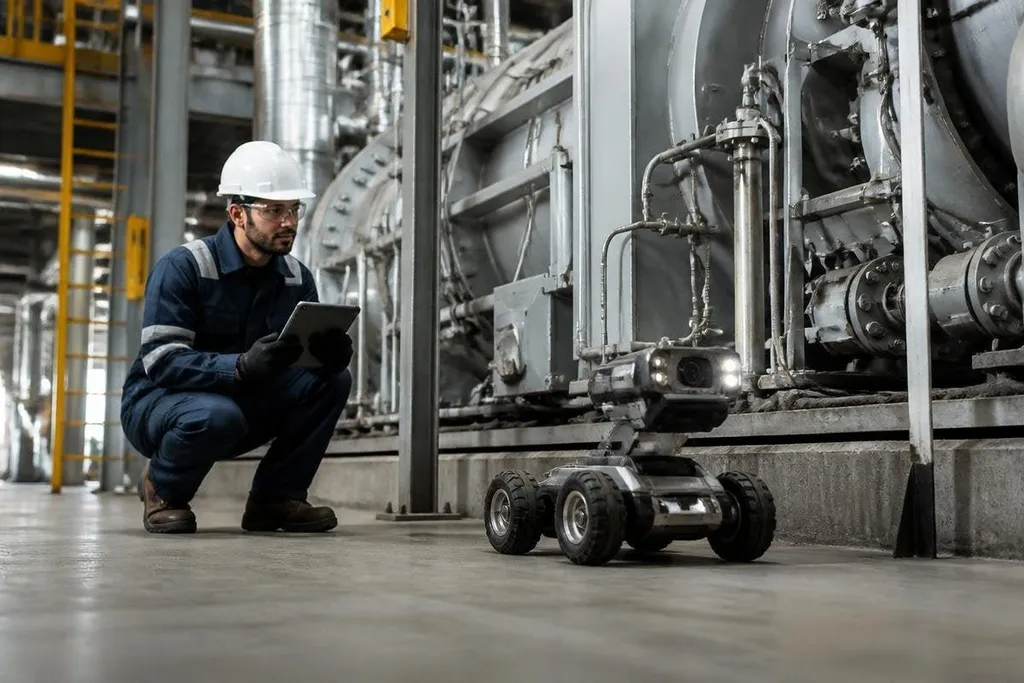
A maintenance robot can inspect equipment, clean hard-to-reach areas, or carry tools through a site. Its value starts when it helps a technician find a fault before that fault stops a machine.
For a plant manager, building operator, or service team, the question is practical: which jobs can a robot do safely, and where does a person still need to make the call?
Quick read
- Cameras, LiDAR, thermal sensors, and vibration sensors give maintenance robots different ways to check equipment.
- The best first jobs are repeatable inspections in places that are dirty, risky, or costly to reach.
- A robot still needs a clear response plan when it finds a fault.
Why maintenance work suits robots
Maintenance includes many tasks that repeat on a set route. A robot can travel that route, collect the same type of data, and send the results to a technician for review.
A camera can record a belt, pipe, panel, or machine housing. A thermal camera can show a hot connection that looks normal to the eye.
LiDAR, which measures distance with laser pulses, can help the robot build a map and return to the same inspection point. Vibration sensors add another useful signal.
A motor may look fine from the outside while its vibration changes as a bearing wears. The robot does not need to repair that bearing to help; finding the change early gives the service team time to plan the work.
That repeatable record matters. A technician can compare a new image, temperature reading, or vibration reading with earlier data instead of relying on memory from the last visit.
Where the machines can help
Maintenance robots fit work that has a clear route, a clear sensor task, and a safe way to respond. Examples include checking storage tanks, inspecting solar panels, cleaning floors, and looking for leaks or damaged equipment.
Some sites also use mobile robots to carry parts between a workshop and a production area. That can leave technicians with more time for diagnosis and repair, though the robot still needs doors, lifts, charging points, and routes that people do not block.
The work becomes harder when the robot must understand an untidy site. Loose cables, temporary barriers, wet floors, poor lighting, and moving vehicles can change the route from one shift to the next. A machine that works well on a mapped path may need a person to guide it around a new obstacle.
Field reports matter here because a route that changes each shift can expose limits hidden by a fixed demo. Maintenance robot reports from Robot24.com can show what the machine did on site and where a person still had to guide it.
The limits that buyers need to plan for
A maintenance robot can collect data, but data alone does not fix equipment. Someone must decide whether a reading shows normal wear, a fault that needs work soon, or a false alarm caused by dirt, lighting, or a sensor problem.
Access is another limit. A robot may reach a long corridor but fail at a narrow stairway, a heavy door, or a surface with poor traction. A robotic arm may reach a valve, yet lack the force or grip needed to turn it safely.
Safety planning also matters. The site needs rules for people and robots sharing the same space. That can include speed limits, warning lights, emergency stops, marked routes, and a clear process for removing the robot when work changes.
I’d start with inspection before repair. Inspection gives you a clear measure of the robot’s work, while repair adds force, tools, safety risks, and more ways for a small error to damage equipment.
A practical buying check
Use these questions before choosing a maintenance robot:
- Name the route: Can the robot reach each inspection point without lifts, stairs, or manual handling?
- Name the signal: Will it use images, heat readings, sound, vibration, or more than one sensor?
- Set the response: Who checks an alert, and how quickly must they act?
- Test the site: Run the robot near doors, people, vehicles, wet surfaces, and temporary barriers.
- Count the work: Record inspection time, false alerts, charging stops, and technician hours before judging the result.
The first useful deployment may be small. One route, one fault type, and one team can show whether the robot finds problems that people miss and whether the follow-up work fits the site.
That evidence should decide the next step: add more routes, change the sensors, or keep the robot on a narrow job where it can produce a repeatable record.